Patio vs. Decking: Which Is Right for Your Newark Garden?
Patio or decking, which is better for your Nottinghamshire garden? We break down the real differences to help Newark homeowners choose with confidence.

Patio or Decking: Which Is Better for Your Newark Garden?
Choosing between a patio and decking is one of those decisions that sounds straightforward until you actually start thinking it through. Both create a usable outdoor space. Both look great when done well. But they suit different gardens, different soil conditions and different lifestyles, and getting it wrong can cost you years of frustration.
We install both across Newark-on-Trent, Balderton, Collingham, Southwell, Fernwood, Coddington, Farndon, Sutton-on-Trent and the wider Nottinghamshire and Lincolnshire area. Here is what we genuinely tell homeowners when they ask us this question.
What Is the Difference Between a Patio and a Deck?
A patio sits at ground level (or very close to it) and is built on a solid prepared base, typically concrete or compacted hardcore, with slabs, stone or similar materials laid on top. It is fixed, heavy and permanent.
Decking is a raised or ground-level timber (or composite) platform, built on a frame of joists and posts. It sits above the ground rather than on it, which makes it particularly useful where the ground slopes or where you want to create a level surface without major groundwork.
Both serve the same basic purpose. The right choice depends on your specific garden.
How Your Garden in Nottinghamshire Shapes the Decision
The East Midlands clay-heavy soil found across much of Nottinghamshire, including around Newark and out towards the Lincolnshire border, can shift and settle. A patio needs a properly prepared concrete base to cope with this. We always dig out to the right depth, lay compacted hardcore and pour a solid concrete sub-base before any slabs go down. Skip that preparation and you will have a wonky patio within a couple of seasons.
Decking, by contrast, sits on posts and joists above the ground. It can flex slightly with seasonal movement, which is one reason it handles uneven or sloping plots well. If your garden drops away from the house, as many do on the newer estates in Fernwood and Coddington, decking can create a level usable area without the need for significant ground excavation.
If your garden is flat and you want a low-maintenance surface, a well-laid patio is hard to beat. If your ground slopes, or you want to raise the outdoor living area to match a raised internal floor level, decking is often the more practical answer.
Maintenance: What You Are Actually Signing Up For
This is the question most people do not ask early enough.
Patios are relatively low maintenance, but they are not zero maintenance. Moss, algae and general grime build up over time, particularly on north-facing areas or shaded spots. A regular jet wash keeps them looking good. We cover this in more detail in our article on patio jet washing and how often you should clean your patio in Newark, but the short answer is once or twice a year is usually enough to keep slabs in good shape.
Decking requires a bit more attention. Timber decking needs treating every year or two to protect against moisture, and even composite decking (which is made from a mix of wood fibre and plastic) benefits from a regular clean to prevent algae and slippery surfaces. Composite decking is more durable and longer-lasting than traditional softwood, but it does carry a higher upfront investment.
If low maintenance is a priority, a quality patio on a solid base generally wins over time.
The 30cm Rule for Decking: What It Means for Your Garden
One question that comes up regularly is about the 30cm rule. In England, decking over 30cm above ground level may require planning permission. This is a building regulation boundary that applies to raised structures, and it is worth being aware of before you commit to a design.
Most domestic decking we install sits at or below that threshold, particularly on flatter plots in places like Balderton or Southwell. But if your garden slopes significantly and you are considering a raised platform, it is worth checking with your local planning authority before work begins. We will always flag this during the planning conversation.
Timber, Composite or Stone: Getting the Material Right
For patios, the most common choices are:
- Natural stone (sandstone, limestone, slate): beautiful, durable and timeless. Requires sealing to protect against staining.
- Porcelain slabs: extremely hard-wearing, low-maintenance and increasingly popular across Newark and Nottinghamshire. Less porous than natural stone.
- Concrete slabs: practical and cost-effective for larger areas or utility spaces.
For decking, the main choice is between:
- Softwood timber (pressure-treated pine): the traditional option. Needs regular treatment but looks warm and natural.
- Hardwood (e.g. oak, ipe): more durable than softwood, naturally resistant to rot, but more expensive.
- Composite decking: the fastest-growing choice. Made to look like timber but with far less maintenance. Does not rot, does not splinter and holds its colour well.
There is no single right answer. It depends on your budget, your taste and how much time you want to spend on upkeep.
What Our Customers Say
David, one of our customers, put it simply:
"Really happy with the patio and garden work carried out by Mowtivated Garden Care. Everything was left neat, tidy, and exactly as discussed. Reliable service and great attention to detail. Would definitely recommend."
That attention to detail David mentions is something we take seriously on every job, whether it is a large natural stone patio in Southwell or a composite deck on a sloped plot in Farndon. Getting the base right, the falls correct and the finish clean is what separates a job that lasts from one that causes problems down the line.
Combining Both: A Practical Option for Larger Gardens
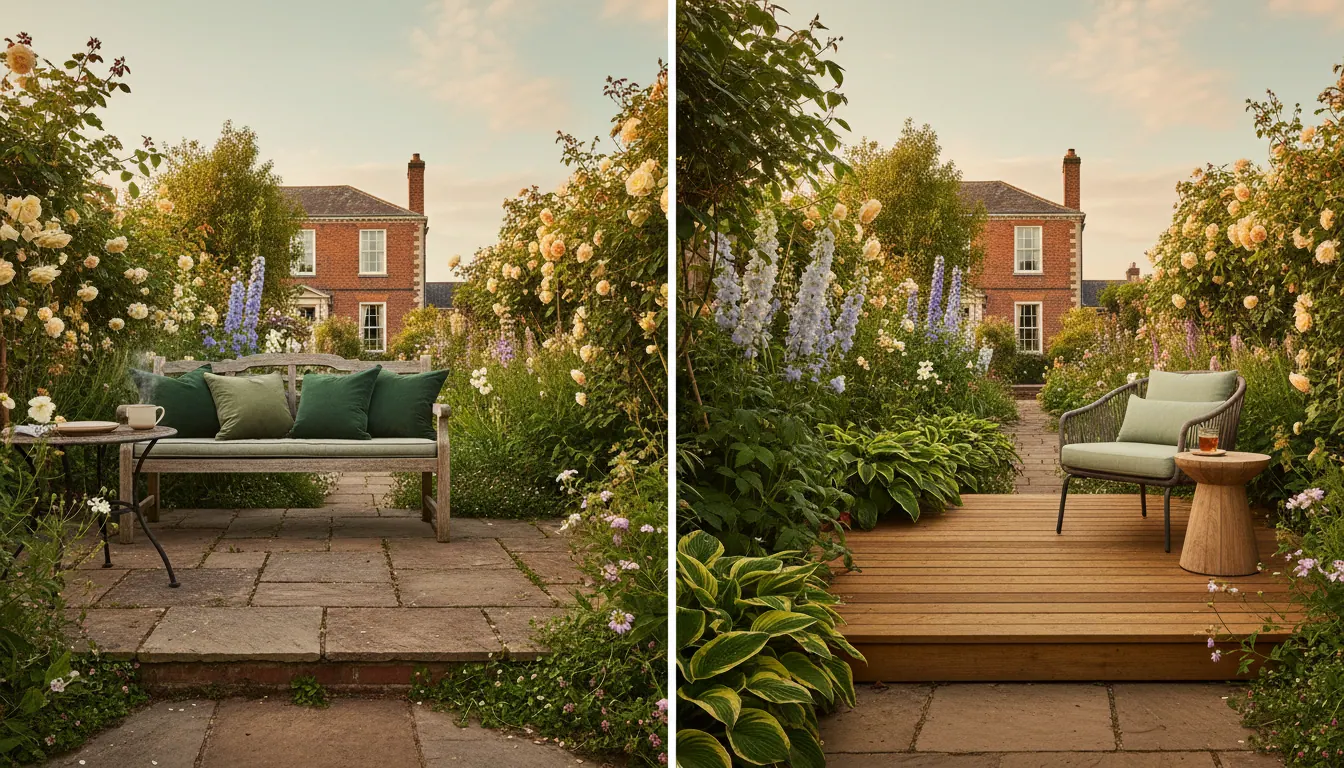
It is worth saying that patio and decking do not have to be an either/or choice. Many gardens across Nottinghamshire and Lincolnshire benefit from both. A patio directly outside the back door, perhaps in porcelain or natural stone, transitions well to a raised composite deck at the bottom of the garden. The two materials complement each other and give the space distinct zones for different uses.
We plan these combinations regularly, particularly on larger plots in Collingham and Sutton-on-Trent where there is room to create genuinely separate outdoor rooms.
Frequently Asked Questions
What is the difference between a deck and a patio? A patio is a ground-level hard surface built on a prepared base, typically using stone, porcelain or concrete slabs. Decking is a raised or ground-level timber or composite platform built on a frame of joists. Both create usable outdoor space, but they suit different garden shapes, soil conditions and budgets. In Newark and across Nottinghamshire, the choice often comes down to whether your garden is flat or sloped, and how much ongoing maintenance you are happy with.
What is the 30cm rule for decking? In England, raised decking that sits more than 30cm above ground level may require planning permission. Most standard domestic decking installations sit below this threshold, but if your plot slopes significantly, it is worth checking before you commit to a design. We always discuss this with customers during the planning stage so there are no surprises.
Is composite decking worth it compared to a patio? Composite decking costs more upfront than a basic patio, but it requires significantly less ongoing maintenance than timber. It does not rot, warp or splinter, and it holds its appearance well over time. For homeowners across Nottinghamshire and Lincolnshire who want a clean, contemporary look with minimal upkeep, composite decking is a very strong option. That said, a quality porcelain patio on a well-prepared base is also low maintenance and extremely durable, so it really depends on your garden and your priorities.
Which lasts longer, a patio or decking? A well-laid patio on a proper concrete sub-base can last for decades with minimal intervention. Natural stone and porcelain are particularly hard-wearing. Timber decking has a shorter lifespan without regular treatment, but quality composite decking significantly closes that gap. The key factor for both is the quality of the preparation and installation. A patio laid on an inadequate base will fail early. Decking with poorly treated timber will deteriorate quickly. Getting the groundwork right from the start is everything.
Still Not Sure? Let Us Help You Decide
If you are weighing up a patio or decking for your garden in Newark, Balderton, Collingham, Southwell, Fernwood, Coddington, Farndon, Sutton-on-Trent or anywhere across Nottinghamshire and Lincolnshire, we are happy to talk it through. Every garden is different, and the best way for us to give you a useful recommendation is to see the space.
You might also find our article on concrete shed bases in Nottinghamshire useful if you are planning any additional garden structures alongside your new surface.
Send us a few photos through the quote form or call us on 07940 769083. We will give you a straight answer and a clear quote based on what your garden actually needs.
Get in touch with us today and let us help you turn your outdoor space from simple to stunning.